How to Build a Content Pipeline That Ships More Videos Without Burning Out

"Post more" is the most common advice on every channel-growth checklist, and it's also the advice most likely to burn someone out. Per vidIQ's own analysis of 5.08 million YouTube channels, channels posting 12 or more times a month grew views 53% faster and subscribers 66% faster than channels posting 1 to 3 times a month, and channels that drop below one upload a month see view growth collapse from over 9.9% down to 1.9%. Frequency matters. But tripling output by working three times harder on the same one-video-at-a-time process is exactly how creators burn out trying to hit it. The fix isn't more effort per video, it's fewer decisions per video.
Why "just do more" breaks people
Every video made one at a time, start to finish, re-invents the same decisions: what's the intro this time, what's the thumbnail style, how should this be paced, is this cut good enough. None of those decisions are hard individually. Repeated 12 times a month, they're what actually exhausts people, not the editing itself. Adobe's 2026 Creators' Toolkit Report asked creators what they'd do with time freed up from routine work: 22% said learning new creative skills, 21% said higher-level creative ideas and direction. Almost nobody said "make more of the same thing faster." The goal of a real pipeline isn't to cram more output into the same hours, it's to remove the repeated decision-making so the hours that are left go toward the parts that actually need a person thinking.
The five-stage pipeline
This is the structure we build for channels trying to scale output without scaling burnout. Each stage is deliberately separated from the next, so no single sitting is trying to do everything at once.
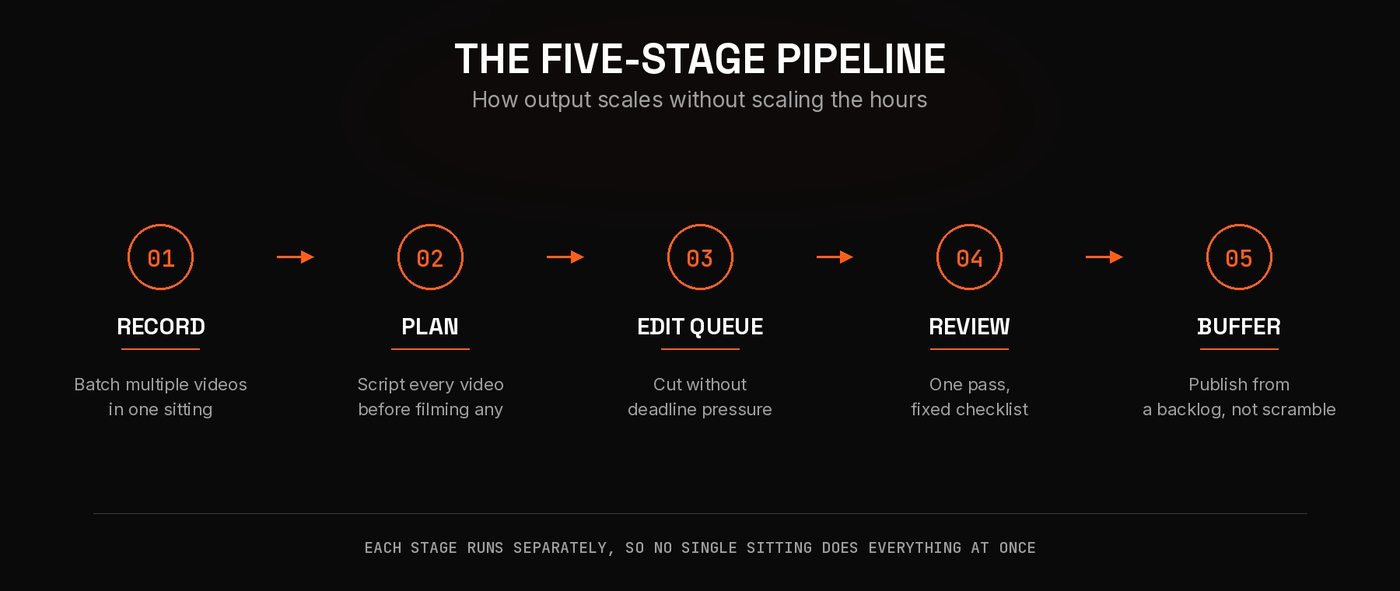
1. Batch the record, separate from everything else. Film multiple videos in one sitting instead of one video per session. The setup cost, lighting, mic check, wardrobe, is the same whether you're shooting one video or five, so paying it once instead of five times is the single biggest time recovery in this whole system.
2. Batch the plan before you batch the record. Script or outline every video in the batch before filming any of them, not one at a time between takes. Switching between "what am I saying" and "how am I saying it" mid-shoot is where sessions run long and energy drops early.
3. Move editing into a queue, not a rush. Once footage exists, it goes into an edit queue instead of getting cut immediately under deadline pressure. A queue with a few videos in it means no single video's edit is happening under the stress of "this needs to be live tonight," which is where rushed cuts and skipped review actually happen.
4. Review once, with a checklist, not repeatedly by feel. Open-ended "does this feel right" review cycles are where hours disappear. A short, fixed checklist, does the hook land in the first few seconds, does pacing match the platform, are captions and audio clean, catches what actually matters without re-watching a cut five times looking for a feeling.
5. Keep a buffer, publish from the bank. The upload calendar pulls from a small backlog of finished videos, not from whatever got finished that afternoon. A 2-to-3-video buffer means one bad week, sickness, travel, a slow edit, doesn't break the upload streak, which is exactly the consistency vidIQ's data ties to growth.
Start with one stage, not five. Building all five at once is its own way to burn out before the pipeline even runs. Pick whichever stage is currently costing the most time, for most creators that's batching the record, film two videos back to back instead of one, and run just that change for two weeks before adding the next stage.
Two channels that ran this playbook
We've run a batched pipeline like this with real clients, not just as a framework on paper. For one faceless channel in a slow-build niche, we've handled the batched edit on roughly 10 long-form videos a month since the very start of the relationship, close to three years now, and the channel grew from 0 to 16,000 subscribers over that time. That growth was gradual, not overnight, the niche itself builds slowly, but the consistent batched output is what kept it moving instead of stalling out. For a second faceless channel, we came in with a 5-to-6-video-a-month batch pipeline when the channel was already at 50,000 subscribers, and it grew to 200,000 before we stopped working together. Both engagements were editing only, not full channel management, and that's part of why both relationships eventually wound down: faceless and cash-cow channels need their content style and angle to keep shifting with the trend cycle, and that's a content-strategy decision a batched edit pipeline alone doesn't solve. The pipeline gets the output out consistently. Someone still has to decide what the content should be.
Templates are what make batching actually work
Batching only saves time if you're not re-deciding the same creative choices in every batch. A fixed intro structure, a consistent thumbnail template, a defined caption style, a standard lower-third look, these aren't creative limitations, they're what makes step 1 through step 5 above fast enough to actually run every week instead of becoming its own project. The channels that burn out running a "pipeline" usually have all five stages but no templates, which means every batch still starts from a blank page.
When the bottleneck stops being about the system
At some point, a well-run pipeline still hits a ceiling: there's only so much editing time one person has, no matter how efficient the queue is. That's less a pipeline problem than a capacity problem, and it shows up as a full buffer that never seems to grow, or a review checklist that keeps getting skipped because there isn't time to run it properly. We walk through what that handoff actually looks like in practice in inside our AI-enhanced editing workflow, the point isn't that a pipeline stops working, it's that the pipeline can only move as fast as its slowest stage lets it.
FAQ
How many videos should I batch at once? There's no fixed number that works for every channel, but most creators find 3 to 5 videos per batch is enough to recover the setup-cost savings without the batch itself becoming an exhausting all-day shoot. Start smaller and scale the batch size once the system is running smoothly.
Does posting more often actually help a channel grow? Per vidIQ's analysis of 5.08 million YouTube channels, channels posting 12 or more times a month grew views 53% faster and subscribers 66% faster than channels posting 1 to 3 times a month. Consistency compounds, which is exactly why a buffer that prevents missed weeks matters more than any single video being perfect.
What's the difference between a content pipeline and just batching filming? Batching filming is one stage. A full pipeline separates planning, filming, editing, review, and publishing into distinct stages with a buffer between them, so a slowdown in one stage doesn't immediately break the upload schedule.
How do I know if I need to bring in an editor instead of just organizing my own process better? If the buffer stage never fills up and the review checklist keeps getting skipped for time, that's usually a capacity ceiling, not a systems problem, no amount of better organizing recovers hours that don't exist.
A pipeline gets you further before you hit a wall, but it doesn't move the wall. If editing is the stage where your buffer keeps running dry no matter how well the rest of the system runs, that's usually the point to hand that stage off rather than keep squeezing it. Book a call, or see how we actually run a project first.
Want Your Content Edited Like This?
Hand off the editing and keep the creative direction. EDITRS handles the rest.