Why AI Video Editing Went Mainstream on YouTube in 2026

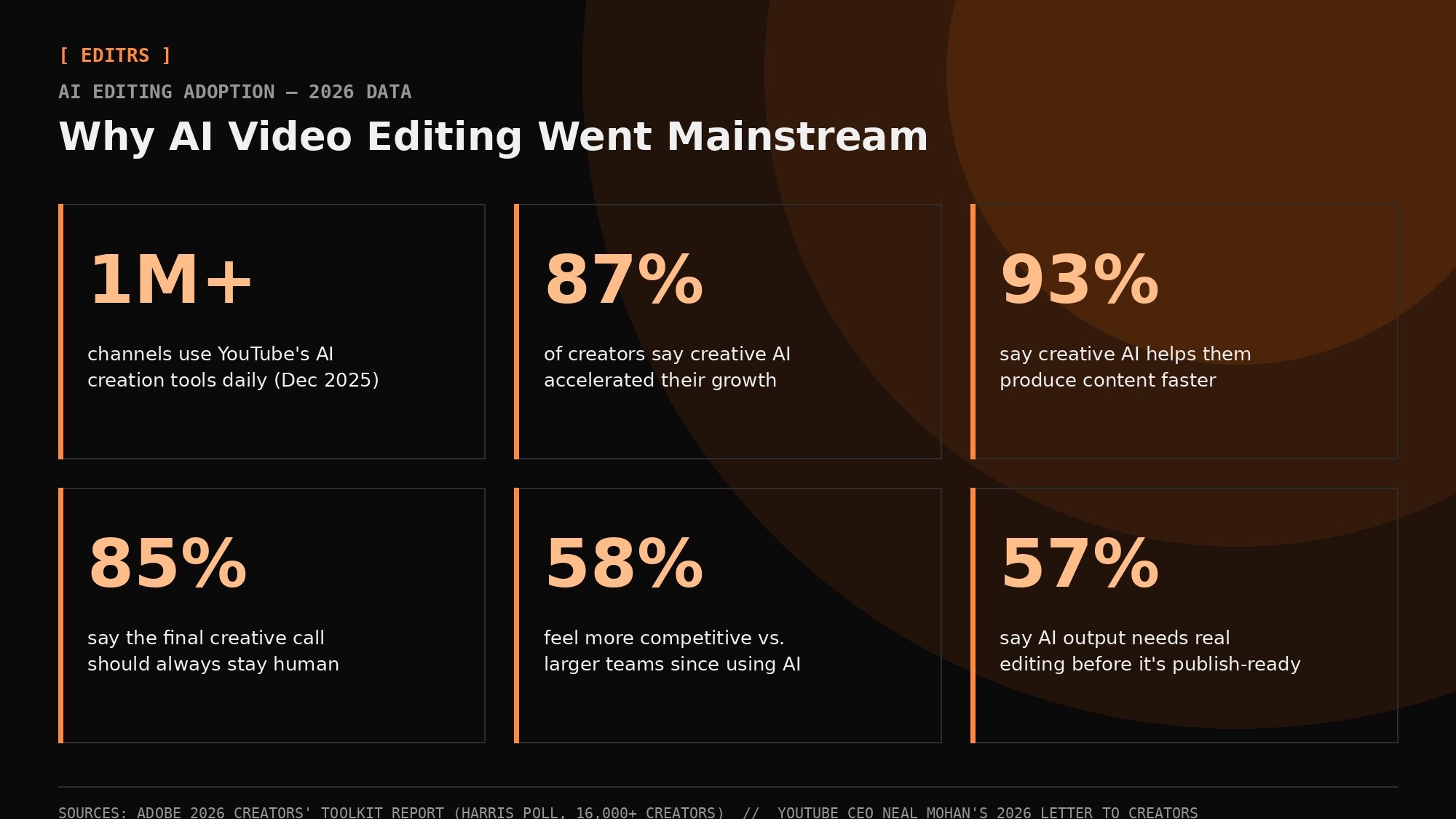
More than 1 million YouTube channels used YouTube's own AI creation tools every single day in December 2025, according to CEO Neal Mohan's 2026 letter to creators. Separately, Adobe's 2026 Creators' Toolkit Report (a survey of over 16,000 creators across eight countries) found that 87% of creators using creative AI say it has accelerated the growth of their business or audience. Neither number is about AI making better creative decisions. Both are about creators producing more, faster, without more hours in the chair.
Here's what the data actually shows, what creators say AI is and isn't doing for them, and where the real risk shows up.
The numbers behind the shift
- 1,000,000+: average daily YouTube channels using YouTube's built-in AI creation tools in December 2025 (Neal Mohan's 2026 letter to creators).
- 87% of creators using creative AI say it's accelerated the growth of their business or follower base (Adobe 2026 Creators' Toolkit Report).
- 93% say creative AI helps them produce content faster (same Adobe report).
- 75% describe creative AI as integrated or essential to how they work (same report).
- 58% say their ability to compete with larger teams or studios feels stronger since using creative AI.
That last stat is the one worth sitting with if you're a solo creator or a small channel. AI-assisted editing is one of the few tools that's actually narrowing the gap between a one-person channel and a production team, not just speeding up big studios that were already fast.
What creators say AI is actually doing for them
Adobe's report (based on a Harris Poll survey fielded in May 2026) breaks down what creators get out of creative AI beyond raw speed:
- 35% say it gives them more freedom to experiment before committing to an idea.
- 33% say it gives them the confidence to pursue more ambitious projects.
- 48% say it makes them feel more secure about their future as a creator.
None of this is about AI replacing the creative work. It's about AI removing enough friction from production that creators can afford to try things they'd otherwise skip.
What still needs a human
This is the part that doesn't make it into most "AI is taking over" narratives, and it's the most important finding in Adobe's report:
- 85% of creators say the final creative decision should always remain with them, whether they're using generative or agentic AI.
- 81% say human judgment remains essential to creative taste.
- 57% say their AI-generated outputs typically need moderate or extensive editing before they're ready to publish.
Put together: creators are using AI to get to a first draft faster, not to skip the editing process. The tools accelerate the start of the work. A person still decides what's actually good enough to publish.
That matches what we see on the ground at EDITRS. AI tools are built to produce the generic version of a shot or a scene. They don't know which choice actually serves the specific story you're telling. Video editing is a form of visual storytelling, and a visual story with no emotion in it doesn't land, no matter how technically clean the cut is. Where to hold a beat, how a moment should feel, when a cut needs to breathe instead of snap: that's still a human call, and it's the part AI can't make for you.
The risk: content volume and "AI slop"
Adobe's report also surfaced a tension worth taking seriously. Among creators who say it's harder to stand out today than a year ago, 53% blame sheer content volume, and 42% specifically point to AI-generated content making it harder for unique voices to be heard.
YouTube's own leadership is treating this as a real problem, not just creator anxiety. In the same 2026 letter that revealed the 1-million-channels-a-day figure, Neal Mohan named "managing AI slop" as a stated priority for the platform this year, alongside stronger disclosure requirements for realistic AI-altered or synthetic content.
The read here isn't "avoid AI editing." It's that the channels benefiting from AI adoption are the ones using it to clear routine work off their plate, not the ones using it to replace the judgment calls that make a video worth watching. Adobe's data backs this up directly: 85% of creators say their AI-assisted work still reflects their unique voice, but only when they're the ones making the final call.
What this means for your channel
If you're not using AI-assisted editing tools yet, the numbers above are less about falling behind creatively and more about falling behind on output. 1 million+ channels a day are already using it to produce more without adding hours.
If you're already using AI tools, the risk isn't the tools themselves. It's letting them make calls that Adobe's own data says creators overwhelmingly want to keep for themselves: what's actually ready to publish, and what makes a video sound like you instead of like every other AI-assisted upload in your niche.
One thing the adoption numbers above don't capture: AI isn't automatically the cheaper option, especially on smaller projects. It genuinely saves time and money at scale, which is part of why adoption has moved this fast. But on a smaller job, you rarely get the shot you actually want on the first generation. It doesn't matter how good the prompt is: getting to something usable usually takes a few rounds of regeneration, plus real adjustments in post on top of that. On a budget that was supposed to be the "AI made this cheap" budget, that adds up fast.
FAQ
How many YouTube channels use AI editing tools? More than 1 million channels used YouTube's built-in AI creation tools every day on average in December 2025, according to CEO Neal Mohan's 2026 letter to creators.
Does using AI editing tools actually help creators grow? According to Adobe's 2026 Creators' Toolkit Report, 87% of creators using creative AI say it has accelerated the growth of their business or audience, and 58% say it's made them feel more competitive against larger teams or studios.
Do creators still need to manually review AI-edited content? Yes. 57% of creators say their AI-generated outputs need moderate or extensive editing before they're publish-ready, and 85% say the final creative decision should always stay with them, per Adobe's 2026 survey.
What is "AI slop" and why does YouTube care about it? It's the flattened, generic feel that shows up when AI-generated content floods a platform without enough human judgment behind it. YouTube CEO Neal Mohan named managing AI slop a stated priority for 2026, alongside new disclosure requirements for realistic AI-altered content.
The data is consistent on one point: AI editing speeds up production, but the creators pulling ahead are the ones still making the actual creative calls themselves. That's the part that doesn't automate, and it's what we handle at EDITRS.
Want Your Content Edited Like This?
Hand off the editing and keep the creative direction. EDITRS handles the rest.