The YouTube Algorithm and Editing: How Pacing Affects Watch Time
Last verified: August 21, 2026, directly against YouTube's own blog and its official "How YouTube Works" page. One quoted source dates to 2012, still the clearest public statement YouTube has made on this specific point, and nothing more recent from YouTube contradicts it, but treat it as foundational logic rather than a description of today's exact algorithm weights.
Two pieces of editing advice contradict each other constantly: cut it shorter for better retention, or make it longer so people watch more. Per YouTube's own blog, neither trick actually works. Back in a post explaining why YouTube's discovery features focus on watch time, YouTube said outright that creators who "intentionally made their videos shorter in an attempt to get a higher retention rate" don't see the benefit they're expecting, because the system optimizes for "how a video contributes to a longer viewing session on YouTube," not for the retention percentage alone. The same post debunks the opposite trick too: making videos artificially longer doesn't reliably add watch time either, because it gets harder to hold attention through a longer runtime. Pacing isn't a length problem. It's a rhythm problem.
What the algorithm is actually optimizing for
Per Cristos Goodrow, YouTube's VP of Engineering, writing on the official YouTube Blog, the recommendation system learns from over 80 billion signals a day, and those signals build on each other rather than acting as one formula: clicks, watchtime, survey responses, sharing, likes, and dislikes. Clicks alone were an early, flawed signal, YouTube found in 2011 that a click doesn't mean someone actually watched, which is why watchtime was added as a signal in 2012.
Not all watchtime counts equally, either. YouTube measures what it calls "valued watchtime," time spent on a video that the viewer actually considered worthwhile, gathered through in-product surveys asking viewers to rate what they watched from one to five stars. Only four- and five-star ratings count as valued watchtime. YouTube doesn't spell out what specifically drags a video's rating down, but the implication for editing is straightforward: a video that holds attention through padding or repetition instead of content the viewer actually values is exactly the kind of watch time this survey system exists to separate out from the watch time that's genuinely earning its runtime.
Retention percentage and total watch time are not the same number
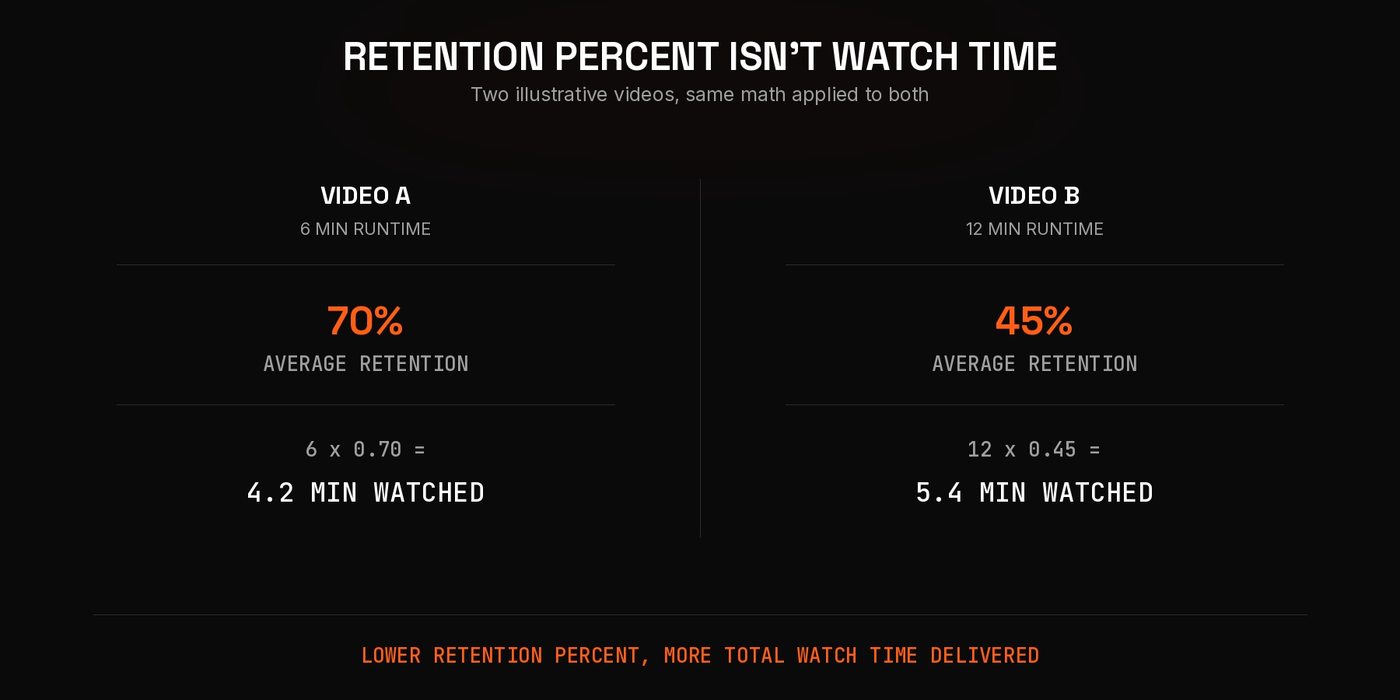
This is the distinction that matters most for editing decisions, and it's easy to miss because YouTube Studio surfaces retention as a percentage, which makes it feel like the target. It isn't, not on its own. A short video with excellent retention can still contribute less total watch time to a viewing session than a longer video with weaker retention.
Here's the arithmetic, using two illustrative videos: a 6-minute video with 70% average retention delivers roughly 4.2 minutes of watched content per viewer (6 × 0.70). A 12-minute video with 45% average retention delivers roughly 5.4 minutes (12 × 0.45), more total watch time, despite the noticeably lower percentage. Neither number alone tells the full story, retention percentage measures how well a specific runtime holds attention, watch time measures the actual value delivered. Editing decisions optimized purely for the percentage can end up working against the number that YouTube's own blog says actually matters to its discovery system.
What this means for pacing decisions in the edit
None of this means "make videos longer." It means pacing needs to be judged by whether it's earning the runtime it's using, not by hitting a target percentage or a target length. In practice, that shows up as a handful of decisions we make on every project:
Cut what isn't earning its place, regardless of how long the video ends up. A slow section doesn't get trimmed because the video needs to be shorter, it gets trimmed because that specific stretch isn't giving the viewer anything a faster version wouldn't also deliver. The runtime that results is whatever the content actually needs, not a number decided in advance.
Vary the rhythm instead of holding one pace for the whole video. A video that's uniformly fast-cut for its entire runtime trains viewers to tune out the urgency, the same way a video that's uniformly slow trains them to disengage. Alternating tighter, quicker sections with slower, more deliberate ones gives each shift in pace something to contrast against, which is what makes a change in rhythm register as meaningful instead of just more noise.
Don't confuse a rewatch with a good pace. A moment that makes someone rewatch it can mean it landed well, or it can mean it moved too fast to follow the first time. Treating every rewatch as a pacing win is a mistake, the fix in the second case is slowing that specific moment down, not celebrating the bump.
Build toward the payoff instead of stretching to reach a runtime. If a video's strongest moment is naturally three minutes in, the honest edit gets there in three minutes. Padding the front half to hit a longer runtime, or rushing past setup to hit a shorter one, both work against the same thing: giving the viewer a version of the video that earns the time it asks for.
FAQ
Does making a video shorter actually improve its chances of being recommended? Not on its own, per YouTube's own blog. Shortening a video can raise its retention percentage without improving how much it contributes to a viewer's overall session, which is what YouTube's discovery system is actually built to reward.
Is a longer video always better for watch time? No. YouTube's own blog specifically warns against this assumption too, longer videos are harder to hold attention through, and a longer runtime with weak retention can deliver less total watch time than a shorter, tighter cut.
What's the difference between retention percentage and watch time? Retention percentage measures how much of a specific video's runtime the average viewer watched. Watch time is the actual amount of time spent watching, in minutes. A video can have strong retention percentage and still contribute relatively little watch time if it's short, or weaker retention percentage and still contribute more watch time if it's long enough.
How does YouTube know if watch time was actually valuable to the viewer? Per YouTube's own blog, the platform uses in-product surveys asking viewers to rate videos from one to five stars, and only four- and five-star ratings count toward what YouTube calls "valued watchtime." Watch time alone isn't treated as automatically positive.
Pacing that actually earns its runtime is a craft decision made shot by shot, not a length target set before the edit starts. If you want that judgment applied to your channel instead of guessing at it project by project, book a call, or read about how we reach the same decisions on every retention graph first.
Want Your Content Edited Like This?
Hand off the editing and keep the creative direction. EDITRS handles the rest.