5 Signs Your Channel Needs a Professional Editor, Not Just a Better Camera

A better camera fixes lighting, sharpness, and low-light noise. It does not fix a slow open, a dip in the middle of your video, or the hours you're still spending cleaning up what an AI tool handed back to you. Those are edit problems, not equipment problems, and no amount of gear spend closes that gap. Here are five signs the bottleneck on your channel is the edit, not the camera.
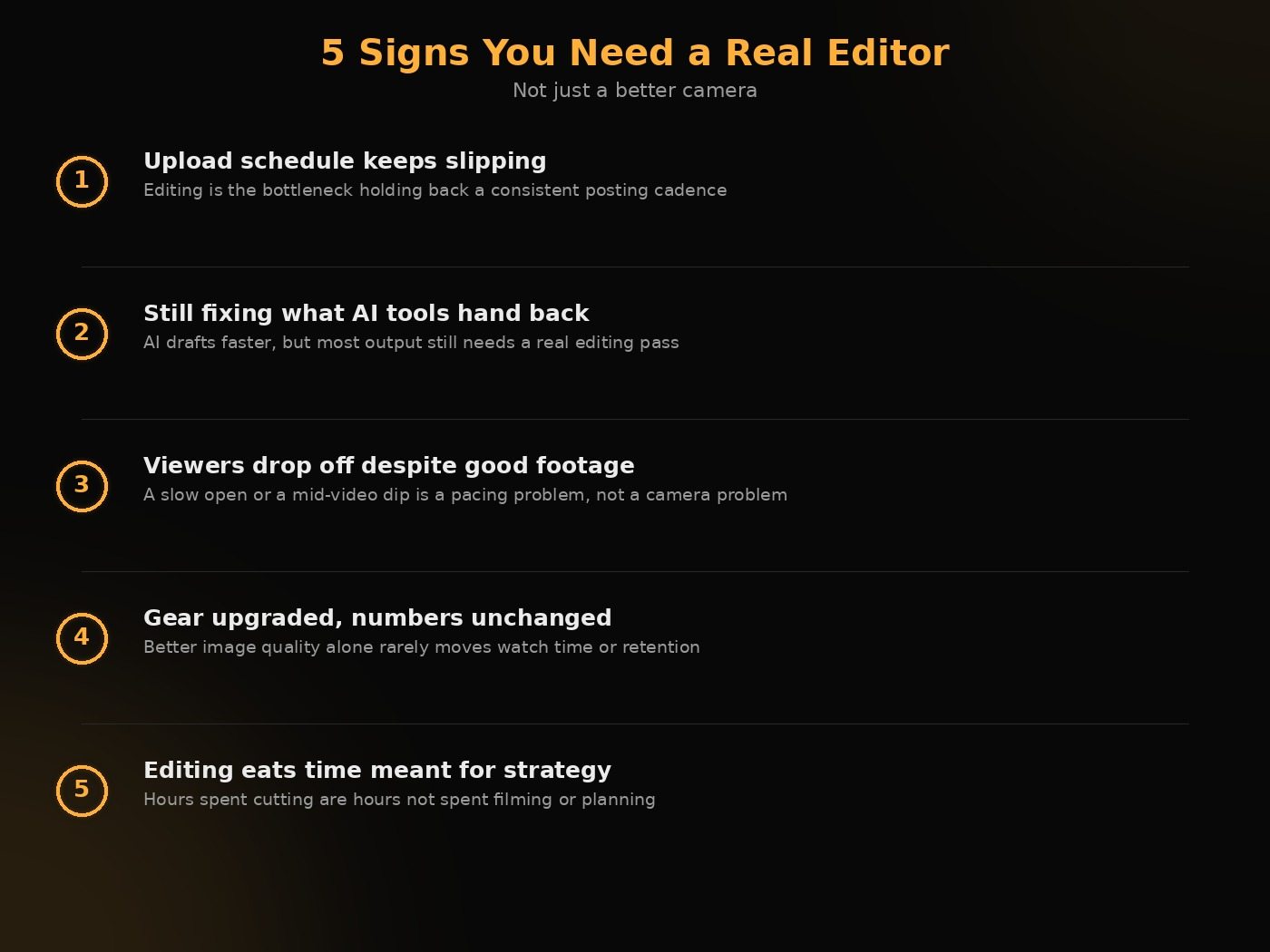
1. Your upload schedule keeps slipping, and editing is why
Per vidIQ's own analysis of 5.08 million YouTube channels, channels posting 12 or more videos a month grew views 53% faster and subscribers 66% faster than channels posting just 1 to 3 times a month. The same analysis found channels that drop below one upload a month see their view growth rate collapse from over 9.9% down to just 1.9%.
If the reason you're not hitting a consistent schedule is that editing eats the time, that's not a minor scheduling issue. Per vidIQ's data, it's a direct cost to how fast your channel grows.
2. You're using AI editing tools, but you're still the one fixing what they produce
According to Adobe's 2026 Creators' Toolkit Report, 93% of creators say creative AI helps them produce content faster, but 57% say their AI-generated output typically needs moderate or extensive editing before it's actually ready to publish. AI tools move you to a first draft faster. They don't remove the editing work, they just relocate it to after generation instead of before.
If you're the one doing that cleanup pass on top of everything else, a professional editor absorbs that step instead of it landing back on your schedule.
3. Viewers drop off early even though the footage looks good
YouTube's own audience retention tools are built specifically to show you whether viewers are leaving in the first moments of a video or dropping off somewhere in the middle, independent of how the footage itself looks. Good lighting and a sharp image don't fix a slow open that doesn't earn its way to what the thumbnail promised, or a stretch in the middle where nothing new is happening. Those are pacing and structure decisions made in the edit, the same intro-window and mid-video-dip pattern we break down in what actually makes a video get watched to the end, and they show up in your retention graph regardless of what camera shot the footage.
4. You've upgraded your gear, and the numbers haven't moved
This isn't a hypothetical, it's the pattern behind one of our own client stories. One client had invested heavily in equipment for almost two years, good cameras, real production value, but was editing in a style that didn't fit the platform they were actually publishing to. Two years of that investment, and the channel hadn't moved. When they came to us and we rebuilt the editing approach around what the platform actually rewards instead of just upgrading gear again, the growth curve started climbing. The equipment was never the problem. The edit was.
5. Editing is eating the time you should be spending on strategy or filming
Adobe's report also asked creators what they'd do with time freed up from routine work: 22% said they'd spend it learning new creative skills, and 21% said they'd put it into higher-level creative ideas and direction. That's what creators reach for when a bottleneck task gets taken off their plate. If editing is currently that bottleneck on your channel, handing it off is what gets that time back, for filming more, planning content, or actually running the business side of the channel.
What this actually means for your channel
None of these five signs are about the quality of your footage. They're about what happens to that footage after it's shot, the cuts, the pacing, the structure that decides whether someone keeps watching, the same handful of habits we cover in common editing mistakes that kill retention. A better camera can't fix any of them, because a camera was never the part of the process responsible for holding attention. The edit is.
FAQ
Does a better camera improve YouTube retention? It improves image quality, not retention directly. Retention is driven by pacing, structure, and how a video's opening earns its way to what the thumbnail promised, decisions made in the edit, not by the camera that captured the footage.
If I use AI editing tools, do I still need a human editor? Usually yes. Per Adobe's 2026 Creators' Toolkit Report, 57% of creators say AI-generated output needs moderate or extensive editing before it's publish-ready. AI tools speed up the first draft; a human editor is still doing meaningful work after that.
Does posting more often actually help a channel grow? Per vidIQ's analysis of 5.08 million YouTube channels, channels posting 12 or more times a month grew views 53% faster and subscribers 66% faster than channels posting 1 to 3 times a month. If editing time is what's limiting your upload frequency, that's a direct growth cost.
How do I know if my retention problem is the edit and not the content idea? Check where viewers are actually dropping off using YouTube's audience retention tools. A drop in the first moments usually points to a slow open. A dip in the middle usually points to pacing or a stretch that isn't earning its place. Both are edit-level fixes, not new video ideas.
If two or more of these sound like your channel, the fix usually isn't more gear, it's someone handling the edit so the footage you're already shooting actually holds an audience. Send us your last uploaded video and we'll show you exactly where the edit is costing you retention, no cost, no obligation. That's a faster way to see the gap than reading five more signs. Book a call and bring the video with you, or see how we actually run a project first if you want to know what happens after.
Want Your Content Edited Like This?
Hand off the editing and keep the creative direction. EDITRS handles the rest.