AI Editing Myths: What AI Still Can't Do Better Than a Human Editor
Most claims about AI video editing aren't wrong, they're just missing the second half of the sentence. AI tools genuinely do speed up editing. They don't remove the editing work, they relocate it. Here are six claims we hear constantly, checked against what the tools and the data actually show.
Myth 1: AI can edit a full video with no human involvement
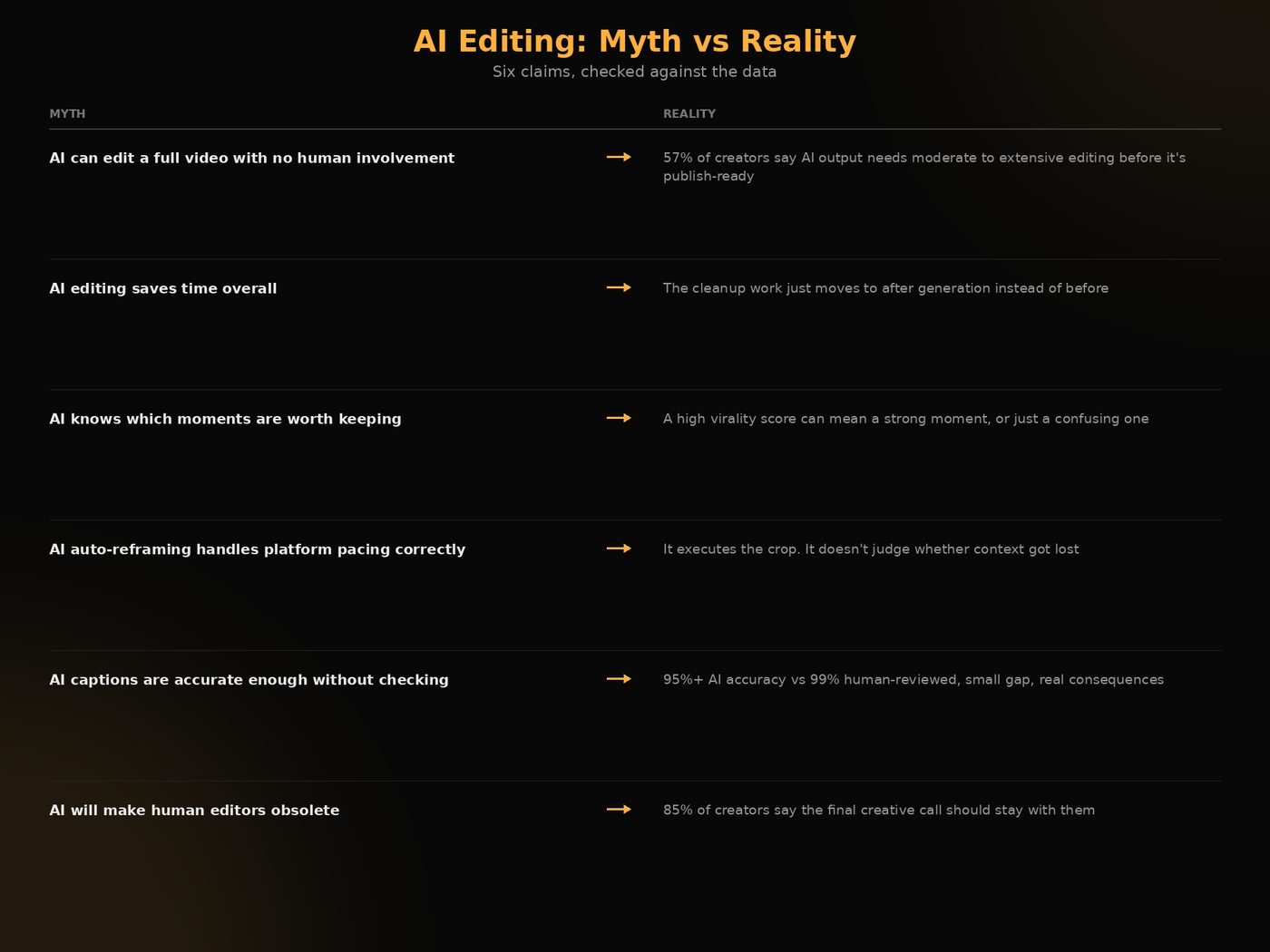
Per Adobe's 2026 Creators' Toolkit Report, 93% of creators say creative AI helps them produce content faster, but 57% say their AI-generated output typically needs moderate or extensive editing before it's actually ready to publish. That's not a fringe number, it's the majority experience. AI gets you to a first draft faster. It doesn't skip the draft-to-final step, it just moves that work to after generation instead of before.
Myth 2: AI editing saves time overall
This follows directly from myth 1, and it's the one that trips people up most. AI does save time on the parts it's good at: transcription, rough cuts, caption generation, background removal. But the 57% of creators who report needing moderate-to-extensive cleanup aren't saving that time, they're spending it later instead of earlier. Whether AI editing is a net time save depends entirely on whether the cleanup pass is shorter than the manual edit it replaced, and for a lot of projects, it isn't.
Myth 3: AI knows which moments are actually worth keeping
Clipping tools score moments for likely performance (a virality score, a retention prediction), and a high score isn't the same as a correct one. As we covered in common editing mistakes that kill retention, a retention spike can mean a moment genuinely landed, or it can mean the moment was confusing enough to force a rewatch, and both produce the same shape on a graph. The same logic applies to AI-flagged clips: as we wrote in how to auto-generate viral shorts, every AI-suggested moment still needs a human pass before it goes anywhere, not just an export. This happens constantly on client work: an AI tool flags a clip as the strongest moment, but the hook it picked doesn't actually land, because the AI has no read on the psychology of why a human keeps watching. That's a judgment call, not a scoring problem, and it's why we change the hook ourselves on client projects far more often than we leave it as generated.
Myth 4: AI auto-reframing handles platform-specific pacing correctly
Auto-reframe tools track a main subject and crop to it, which works fine for a single speaker in a static frame. As covered in Reels vs long-form YouTube, Shorts and Reels aren't just a resize, they're a different pacing and composition decision, and wide shots or multi-subject scenes often lose context a 9:16 auto-crop wasn't built to preserve. The tool executes the reframe. It doesn't decide whether the reframe actually kept what mattered in the shot.
Myth 5: AI captions are accurate enough to publish without checking
Per Rev's own published figures (covered in full in AI captions and auto-subtitles), AI-generated captions run at roughly 95%+ accuracy, versus 99% for human-reviewed captions. A 4-point gap sounds small until it lands on a brand name, a number, or a word that changes the meaning of a sentence, exactly the kind of error a quick manual pass catches and an unreviewed auto-caption doesn't.
Myth 6: AI will make human editors obsolete
Per Adobe's 2026 Creators' Toolkit Report, 85% of creators say the final creative decision should always remain with them, whether they're using generative or agentic AI, and 81% say human judgment remains essential to creative taste. That's not nostalgia, it's the people using these tools daily saying the same thing from the other side: AI changes what an editor spends time on, not whether an editor is needed.
What this actually means
Every myth above breaks the same way: AI tools are genuinely good at the mechanical half of a task, generating a draft, flagging a candidate moment, transcribing speech, cropping a frame, and genuinely inconsistent at the judgment half, deciding whether that draft, moment, transcription, or crop is actually right. That gap is exactly where a human editor's time goes now. Not gone. Moved. It's the same gap we walk through start to finish in inside our AI-enhanced editing workflow, where the AI tools handle the first pass and every one of these six judgment calls still runs through a person.
FAQ
Does AI editing actually save time? Partially. AI speeds up mechanical tasks like transcription and rough cuts, but per Adobe's 2026 Creators' Toolkit Report, 57% of creators say AI output needs moderate or extensive editing before it's publish-ready. That cleanup work still takes time, it just happens after generation instead of before.
Can AI reliably pick the best moments from a long video to clip? It can flag candidates based on patterns like predicted virality, but a high score doesn't guarantee the moment is actually strong versus just confusing enough to force a rewatch. Every AI-suggested clip still needs a human review pass before publishing.
Are AI-generated captions accurate enough to use without checking? Close, but not exact. AI captions typically run around 95%+ accuracy versus 99% for human-reviewed captions, per Rev's published figures. That gap is small in percentage terms but can land on names, numbers, or meaning-changing words.
Will AI replace human video editors? Current creator survey data suggests otherwise. Per Adobe's 2026 report, 85% of creators say the final creative decision should stay with them regardless of how much AI is involved, and 81% say human judgment remains essential to creative taste.
None of this means AI tools aren't worth using, we use several of them ourselves. It means the tools handle the mechanical half of editing, and the judgment half, what's actually worth keeping, what earns a viewer's attention, what's ready to publish, is still the part a person has to do. Send us a project you've run through an AI editing tool and we'll tell you exactly where the judgment gap is costing you. Book a call, or see what that looks like in practice first.
Want Your Content Edited Like This?
Hand off the editing and keep the creative direction. EDITRS handles the rest.